The Quest for "Excellence for All": Understanding Simulation-Based Mastery Learning
The phrase "practice makes perfect" needs a serious update. In medical education, we've learned that not all practice is created equal. Enter simulation-based mastery learning (SBML) - perhaps one of the most powerful yet resource-intensive approaches to procedural skill acquisition we have.
The Theoretical Foundation
What makes SBML particularly fascinating is how it draws upon multiple learning theories simultaneously. McGaghie and Harris illuminate this beautifully in their 2018 paper, showing how SBML sits at the intersection of three major theoretical frameworks:
The Behaviourist Learning Theory is a psychological perspective that explains learning as a process of acquiring new behaviors through interactions with the environment. It is based on the idea that all behaviours are learned through conditioning, which occurs through associations between stimuli and responses. Think of this as the "nuts and bolts" of procedural learning - the measurable actions and outcomes.
Constructivist theory comes into play as learners build their understanding through experience and reflection. This is particularly evident in how learners interpret clinical signs and develop decision-making skills.
Social cognitive theory explains how learners develop self-efficacy and professional identity through observation and guided practice. It's the theoretical basis for why watching others succeed (or struggle) helps us learn.
The Secret Sauce
At its core, SBML comprises several key ingredients:
- Baseline testing (where do learners start?)
- Clear learning objectives arranged in increasing difficulty
- Deliberate practice with expert coaching
- A rigorous minimum passing standard
- Ongoing assessment with actionable feedback
- Advancement only when mastery is demonstrated
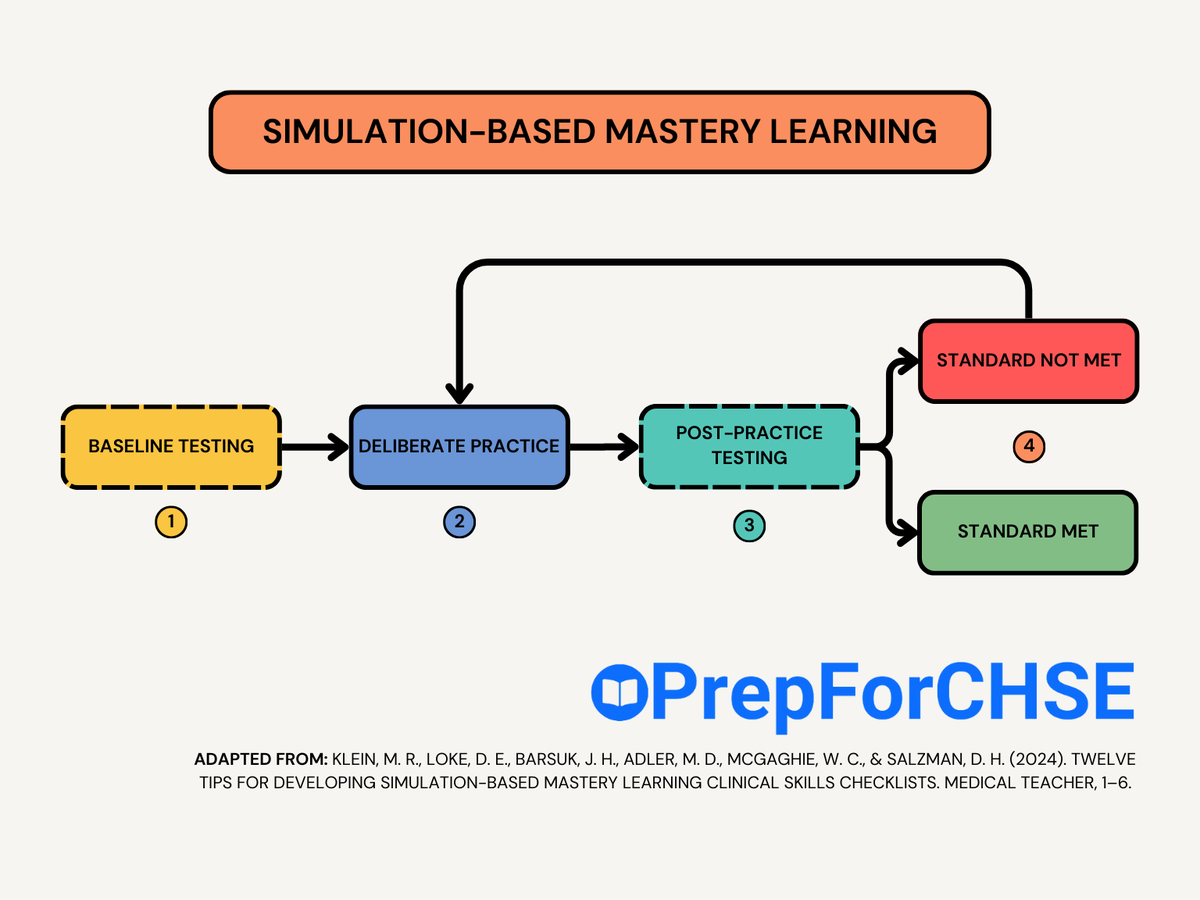
The Core SBML Process
- Baseline Assessment First, learners perform the procedure while being assessed using a validated checklist. This isn't meant to be demoralising; it's about establishing a starting point.
- Deliberate Practice This is where the magic happens. Learners engage in focused practice sessions with expert feedback. Each attempt is measured against specific performance standards. For example, with lumbar puncture, this might include:
- Correct patient positioning
- Proper sterile technique
- Accurate needle insertion
- Appropriate CSF collection
- Safe needle withdrawal and dressing application
- Formative Assessment Throughout the practice phase, learners receive specific, actionable feedback. This isn't just "good job" or "try again" - it's detailed guidance on exactly what needs improvement and how to achieve it.
- Testing for Mastery When learners feel ready, they undergo formal assessment using the same checklist from baseline. The twist? They must meet or exceed a predetermined minimum passing standard (MPS) - often set quite high (typically 85-90%) to ensure true mastery.
- Additional Practice if Needed If mastery isn't achieved, learners return to deliberate practice with focused feedback on specific areas needing improvement. This cycle continues until mastery is achieved.
The Evidence Base
The skeptics among you (and rightly so) might ask - but does it actually work? The research is compelling. Barsuk et al. demonstrated that SBML reduced complications during central venous catheter placement in a medical intensive care unit[1]. In another study, their team showed that simulation-based education with mastery learning improved residents' lumbar puncture skills significantly[2].
Perhaps most impressively, Cohen et al. showed actual cost savings from reduced catheter-related bloodstream infections after simulation-based mastery learning[3].
The Innovation Challenge
Traditional SBML is undeniably resource-intensive. However, recent innovations are making it more accessible. Scahill et al. (2021) described an enhanced approach incorporating pre-learning and peer-assisted components. Their work showed that learners valued all aspects of this modified programme, particularly the peer observation elements.
What's particularly clever about their approach is how it maintains the theoretical underpinnings while making the methodology more scalable. The pre-learning component builds on constructivist principles, while peer-assisted learning leverages social cognitive theory beautifully.
Looking Forward
Despite implementation challenges, SBML represents a gold standard in procedural education. Its theoretical grounding in multiple learning frameworks, combined with robust evidence for improved patient outcomes, makes it a powerful tool in our educational arsenal.
For those preparing for the CHSE exam, understanding both the theoretical foundations and practical applications of SBML is crucial. It represents not just a teaching methodology, but a comprehensive approach to ensuring clinical competence.
[Want to test your knowledge of SBML and other key simulation concepts? Check out our question bank at prepforchse.com]
What are your thoughts on SBML? Have you implemented it in your practice? Share your experiences in the comments below.
References
- Barsuk JH, et al. Simulation-based mastery learning reduces complications during central venous catheter insertion in a medical intensive care unit. Crit Care Med. 2009;37(10):2697-701.
- Barsuk JH, et al. Simulation-based education with mastery learning improves residents' lumbar puncture skills. Neurology. 2012;79(2):132-7.
- Cohen ER, et al. Cost savings from reduced catheter-related bloodstream infection after simulation-based education for residents in a medical intensive care unit. Simul Healthc. 2010;5(2):98-102.
- McGaghie WC, Harris IB. Learning theory foundations of simulation-based mastery learning. Simul Healthc. 2018;13(3S Suppl 1):S15-S20.
- Scahill EL, et al. An enhanced approach to simulation-based mastery learning: optimising the educational impact of a novel, National Postgraduate Medical Boot Camp. Adv Simul. 2021;6:15.
#SimulationEducation #MedEd #CHSE #MasteryLearning
Written by Matt Bowker
Dr. Matt Bowker is a simulation educator and with over a decade of experience in healthcare simulation across multiple continents and student groups.